The agency margin math
- Monthly cost, 50 videosSmartUGC Agency plan $249Creator roster $2,500–$10,000
- Cost per videoSmartUGC Agency plan $5Creator roster $50–$200
- Turnaround per videoSmartUGC Agency plan 2–10 minutesCreator roster Days to weeks
- Revision costSmartUGC Agency plan 1 credit ($5)Creator roster Re-brief, often re-pay
- Coordination overheadSmartUGC Agency plan A script and a clickCreator roster Briefs, shipping, chasing
- Consistent face across campaignsSmartUGC Agency plan Custom avatar, always availableCreator roster If the creator stays available
- Usage rightsSmartUGC Agency plan Royalty-free, no limitsCreator roster Negotiated per creator
The margin problem AI UGC actually solves
Agencies do not have a creative-quality problem; they have a creative-throughput problem with a coordination tax attached. Every client wants fresh UGC monthly. Every video from a human creator costs $50 to $200 plus the unbillable hours of sourcing, briefing, shipping product, chasing delivery, and negotiating usage rights. A five-client roster needing ten videos each is 50 monthly videos, a $2,500 to $10,000 hard cost, and somebody's entire week of herding.
The Agency plan prices that same volume at $249, or $5 a video, with renders in minutes and royalty-free output. Even if you keep human creators for hero content (and you should, more below), moving the testing and variation volume to AI changes retainer economics outright: the $2,000 creative line item becomes $250 of cost against the same billable price, or becomes the room to underbid competitors who still pay creator rates.
The second-order effect matters as much: revision cycles stop being negotiations. A client who wants the hook changed costs one credit and ten minutes, not a re-brief and a creator's goodwill. Agencies that adopt this stop rationing revisions, and clients notice.
Fitting it into client workflows
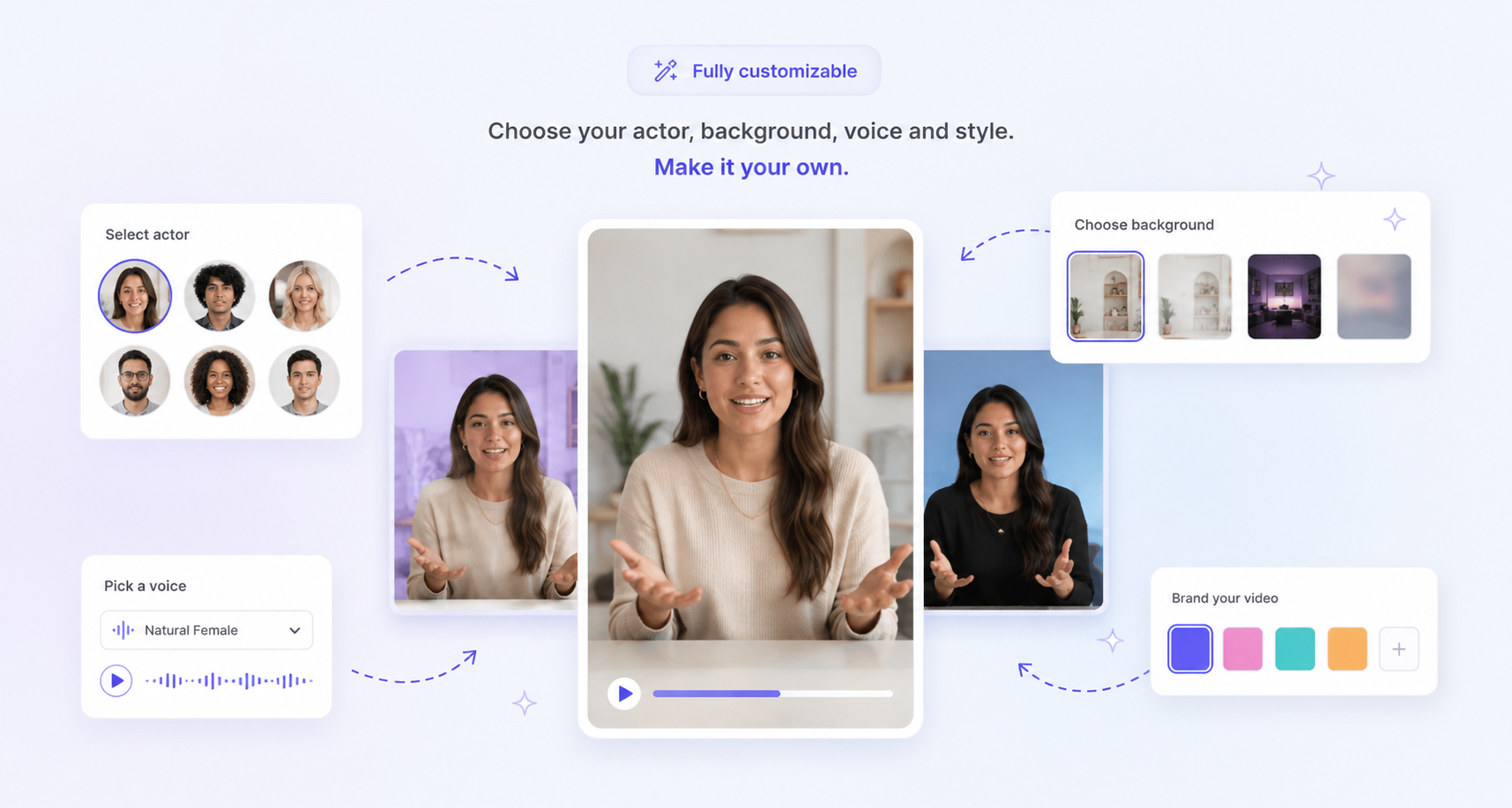
The pattern that works: AI UGC as the volume layer inside your existing creative process, not a replacement for it.
Strategy and scripts stay yours. The tool takes a script and renders a performance; the insight about what angle will move a client's audience is still the thing the retainer pays for. The AI script writer drafts competently, but agencies win on the edit.
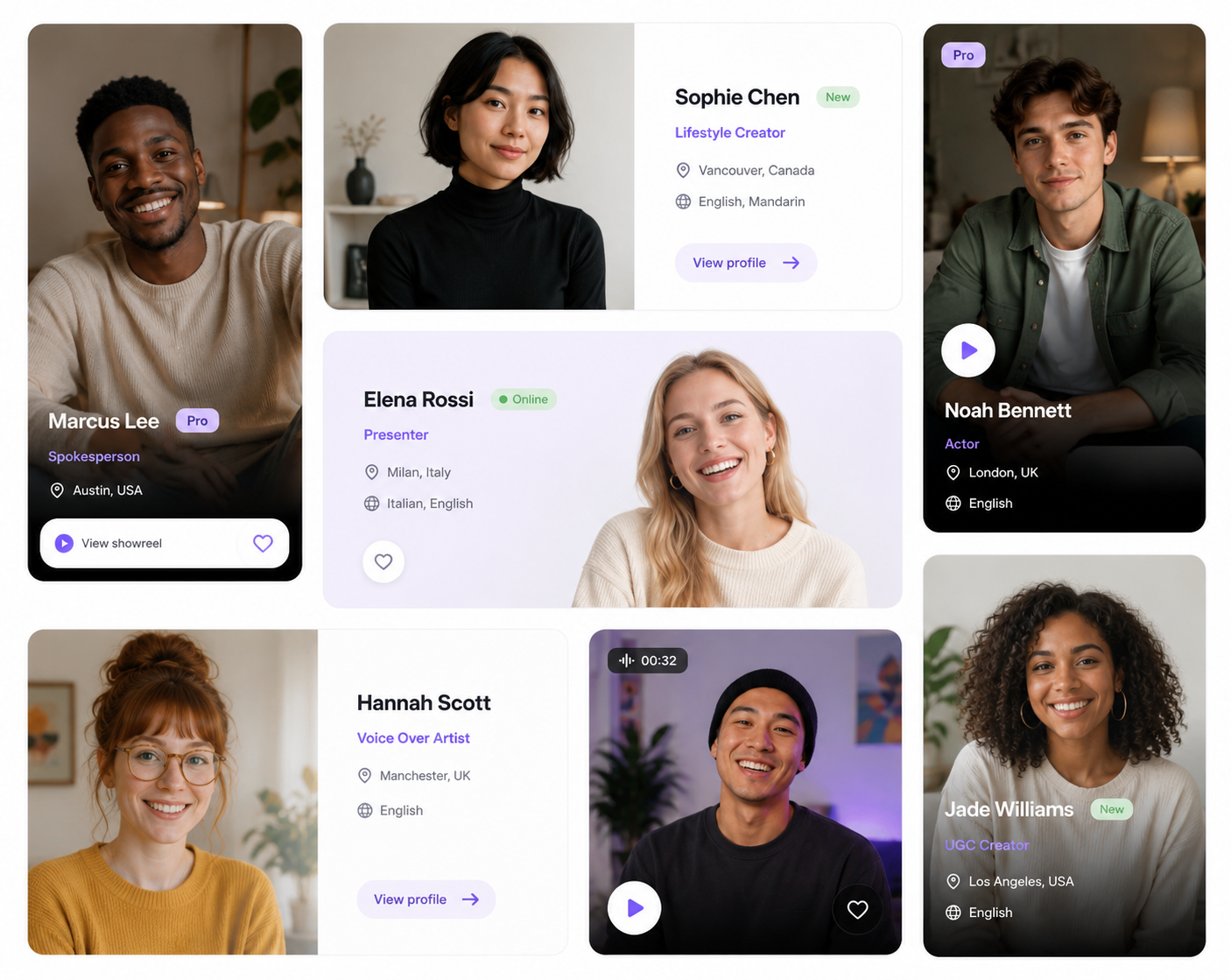
Casting becomes a menu. The full actor catalogue is on every plan, so account teams pick actor-audience fit per client without availability calendars. For clients wanting a consistent face, train a custom avatar (from a clip of the founder, a hired talent with cleared rights, or a synthetic base) and that ambassador is on tap for every campaign, every revision, indefinitely. Custom avatars are included from the $69 plan.
Formats map to the funnel: talking-actor testimonials for prospecting, product-in-hand demos for consideration, B-roll refreshes for retargeting fatigue. All included from the $69 tier; the $249 tier is the same features at volume pricing with priority rendering.
Bulk creation handles the variation matrix (five hooks by two actors in one pass), which is how a junior producer ships a client's monthly test set in a morning.
The questions clients will ask, answered honestly
"Is this disclosed as AI?" Platform rules require synthetic-content disclosure in a growing set of contexts, and the rules move quarterly. Someone at your agency owns staying current per platform; that diligence is billable value now. The assets themselves are royalty-free with no usage limits, which is cleaner than most creator contracts you have negotiated.
"Will it look like everyone else's AI ads?" Only if you use it like everyone else. The floor of this category (default actor, default read, generic script) is recognisable and fatiguing fast. The ceiling (sharp script, considered casting, product-in-hand, B-roll cutaways) reads as produced content. Named video models, Seedance 2.0 and Veo 3, are on every plan, so quality is not gated behind a higher tier. The tool sets the floor; your team sets the ceiling, which is precisely the pitch for keeping an agency involved.
"Why are we paying you if the video costs $5?" Because the $5 buys a render, not a strategy, a script, a test design, or the judgment to kill a loser. Agencies that lead with transparent economics ("creative production is now cheap; you are paying us to aim it") are winning this conversation. Agencies that quietly pocket the delta risk the client discovering the tool themselves, with a worse story attached.
"Can we use our real customers instead?" When you have great customer footage, yes, use it; it will outperform synthetic testimonials on trust. AI carries the volume beneath those anchors.
The tool question, from an agency seat
Agencies evaluate this category on cost per output and how many client accounts one plan can carry, and on those two axes SmartUGC is built for the seat.
The lowest per-video cost in the field is $5, every format sits on one flat plan, and there is no per-seat pricing, so an account team can run the whole roster from a single subscription. Credits roll over when you upgrade mid-cycle, failed generations refund automatically, and the Agency tier adds priority rendering. Public pricing is on the page, so a client can see exactly what a video costs without a sales call.
The rest of the field is worth knowing for client decks. Arcads carries brand weight and, at the time of writing, its in-app custom tier lists team collaboration and API access, though its entry plan starts around $115 a month (£85) with no trial listed; the head-to-head is here. MakeUGC offers a self-serve API and automation, with product-in-hand gated to its $149 tier; verify the burn rate before you commit at volume. Creatify layers in analytics and A/B testing; comparison here. None of them beat $5 a video on a flat, seat-free plan, which is the number that moves agency margin.
For higher volume, white-label needs, or dedicated support, enterprise plans are a conversation, not a form-wall.
Rolling it out without breaking what works
The adoption path that has worked for agencies we have watched:
Month one, internal only. Run the $1 trial, then a Creator or Studio plan against one friendly client's account. Generate variations alongside the existing creator pipeline and let the ad account judge blind. You are building your own case study and your team's prompt instincts before any client conversation.
Month two, the two-tier offer. Reposition human creators as the premium layer (hero spots, genuine testimonials, founder stories) and AI as the always-on testing layer. Price both honestly. Clients rarely drop the premium layer; they add the testing layer, which is new revenue on a $249 cost base.
Month three, scale decisions. If volume across clients passes 50 videos monthly, that is the enterprise conversation (custom volume, support SLAs). If a single client dominates usage, consider whether they should hold their own subscription you manage, which keeps your plan for the roster.
The failure mode to avoid: announcing an "AI creative offering" before your team has taste with the tool. The gap between default output and directed output is the agency's entire value story here. Close it internally first, then sell it.
- Lowest cost per finished video
- One flat plan with no per-seat pricing
- A cheap trial on real, watermark-free ads
- Cost fixed per video, one credit one video
- Product-in-hand and custom avatars on lower plans
- Know exactly what renders your ad
- Scale up without losing what you paid
- Keep running ads after you cancel
- Public pricing clients can check without a call
The volume layer, at volume pricing
Agencies win with AI UGC when it absorbs the coordination-heavy volume work and leaves strategy, taste, and client trust where they were. At $5 a video on the Agency plan, the math is not subtle: one retainer's monthly creative line item covers the tool for the whole roster. Keep the human creators for the anchors. Move the testing to the machine. Start the $1 trial on your own agency's ads first, and sell what you measured.
Questions, answered.
Can we white-label SmartUGC for clients?
The standard plans are agency-friendly (royalty-free output, no per-seat pricing, 50 videos at $249) but not white-labelled. White-label arrangements, higher volume, and dedicated support run through enterprise plans; contact us via the enterprise page and we will build something that fits.
How do usage rights work for client campaigns?
All generated assets are royalty-free with no usage limits: clients can run them anywhere, indefinitely, including after either of you stops subscribing. That is simpler than most human-creator contracts, where usage windows and whitelisting fees need negotiating per video.
Can each client have their own consistent AI creator?
Yes. Train a custom avatar per client (from founder footage, cleared talent, or a chosen catalogue actor used consistently) and that face stays available for every campaign and revision. Custom avatars are included from the $69 plan.
What is the cost per video across a client roster?
On the Agency plan it is $5 a video, one credit for one finished video, with no per-seat charge no matter how many account managers touch the plan. That flat, predictable rate is what makes the retainer margin math work: a fixed cost base against billable creative output.
What happens when we need more than 50 videos a month?
The Agency plan covers 50; beyond that is an enterprise conversation with custom volume pricing, priority support, and API access if you want programmatic generation. Credits roll over when you upgrade plans mid-cycle, so scaling up does not forfeit anything.
Do failed generations cost us a credit?
No. Failed generations are refunded automatically, so a render that does not come out clean does not eat into a client's monthly allowance. Credits also roll over when you upgrade, which keeps the roster's budget intact as you scale.
Can clients see the pricing before we pitch them?
Yes. SmartUGC pricing is public on the page, so a client can verify exactly what a video costs without a sales call. That transparency is an asset in the pitch: you lead with the economics openly rather than defending a hidden markup later.
Which video models does SmartUGC use?
Seedance 2.0 and Veo 3 are named and available on every plan, including the entry tier, so output quality is not gated behind a higher price. Your team sets the ceiling with script and casting; the models set a strong floor everywhere.
Is there a free trial we can test on client work?
There is a $1 trial for the first 3 days with watermark-free output, so you can run real ads on a friendly client's account and judge blind against your creator pipeline before committing to a plan. Cancel anytime.
Should we tell clients the creative is AI-generated?
Yes, and lead with it. Platform disclosure rules increasingly require it anyway, and the agencies winning this transition sell the economics openly: production is now cheap, and the retainer buys the strategy and judgment that aim it. Clients who discover the tool themselves later remember who told them first.
Related guides
The complete toolkit for
modern advertisers.

One subscription. Unlimited creative.
Create scroll-stopping videos
in seconds.
Start now and cancel at anytime — just $1 for the first 3 days.