Matching plan to store size
- SmartUGC planTesting one hero SKU Creator, $69/moScaling 3–5 SKUs Studio, $119/moFull catalogue rotation Agency, $249/mo
- Videos per monthTesting one hero SKU 10Scaling 3–5 SKUs 20Full catalogue rotation 50
- Cost per videoTesting one hero SKU $7Scaling 3–5 SKUs $6Full catalogue rotation $5
- Product in handTesting one hero SKU IncludedScaling 3–5 SKUs IncludedFull catalogue rotation Included
- Custom avatarTesting one hero SKU IncludedScaling 3–5 SKUs IncludedFull catalogue rotation Included
- Sensible splitTesting one hero SKU 6 hooks + 4 B-rollScaling 3–5 SKUs 3–4 videos per SKUFull catalogue rotation 8–10 SKUs in rotation
The creator math every Shopify brand eventually does
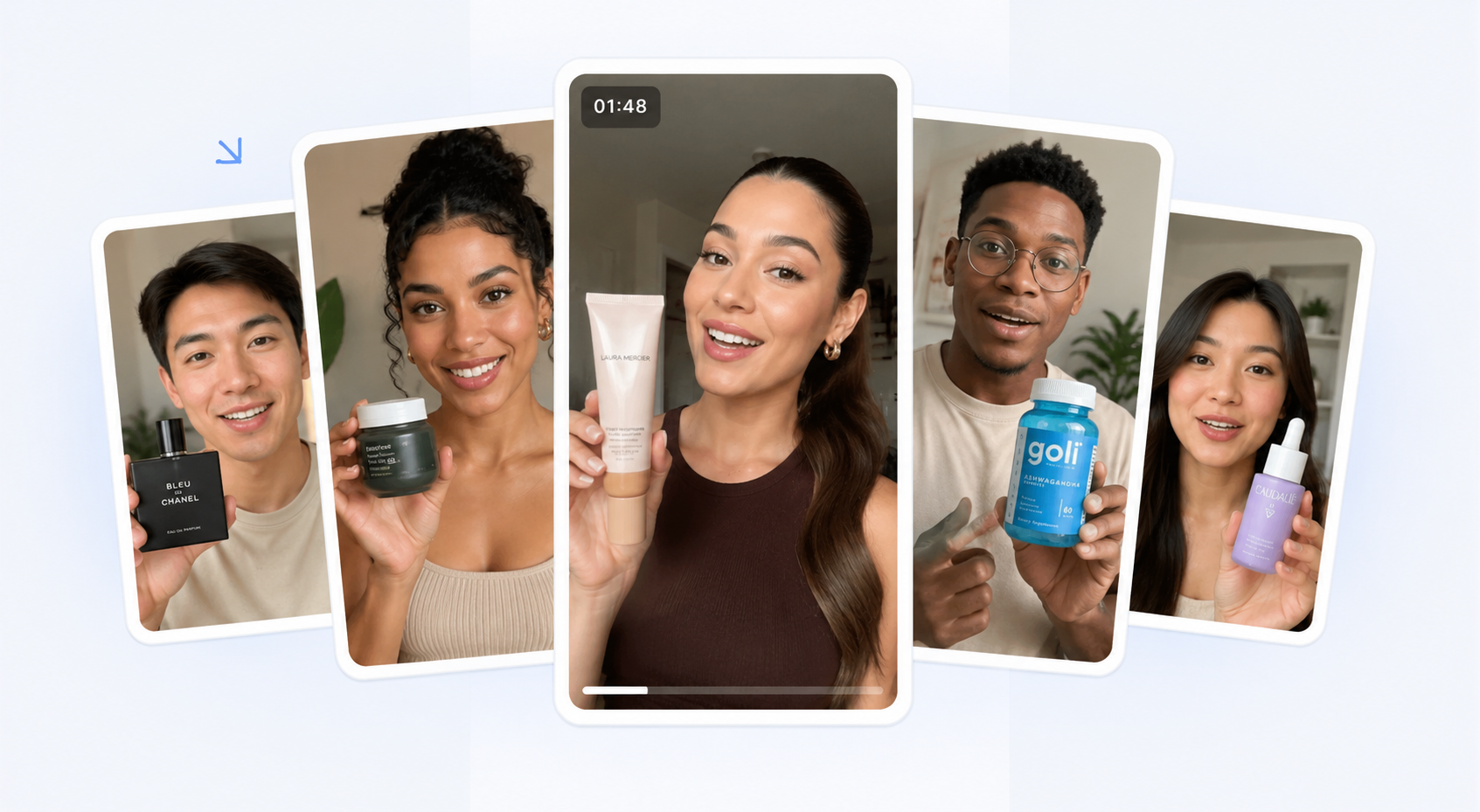
The standard playbook says: find UGC creators, ship them product, wait two weeks, get a video, hope it converts. The invoice for that is $50 to $200 per video, plus product cost, plus shipping, plus the coordination time nobody bills honestly. Testing five hooks for one SKU can cost $500 and a month. Multiply by a catalogue and the playbook quietly dies; most stores end up advertising two products with creative they are afraid to fatigue.
AI UGC inverts the constraint. At $5 to $10 per finished video, the five-hook test costs about $35 and an afternoon. That does not make every video a winner. It makes losing cheap enough to find the winner, which is the actual job of ad creative.
The catch worth stating up front: AI actors are not your customers. A genuinely great customer testimonial still beats a synthetic one, and always will. What AI replaces is the paid stranger reading your script to a ring light, which is what most "UGC" has been for years anyway. Your real reviews stay in the mix; the AI handles volume, speed, and the SKUs no creator wants to shoot.
The workflow, from product page to ad account
The loop for a Shopify store runs like this.
Take your product images, the same ones on your PDP. Upload one to the product-in-hand generator, write what the actor should say and the scene you want ("kitchen counter, morning light, holding the jar label-out"), and generate. The actor holds, shows, and talks about your physical product. This is the format that made AI UGC famous, and on SmartUGC it is included from the $69 plan.
Write the script yourself or let the AI script writer draft from your product description. Hooks matter more than anything after them, so generate several openings for the same body: the price angle, the problem angle, the "I was skeptical" angle.
Add B-roll for the cutaways: the product in use, the unboxing moment, the texture shot. Same tool, same credits, generated from your images and a sentence of direction.
Then export and publish through your normal ads manager. Videos take 2 to 10 minutes to render, so a full creative refresh for a SKU fits between coffee and lunch. The output is watermark-free from the $1 trial onward, royalty-free, and carries no usage limits, so anything you generate is ready to run as a paid ad the moment it finishes.
What a month actually looks like

Take a concrete store: skincare brand, one hero serum, two supporting SKUs, spending $8K a month on Meta.
Week one, the hook hunt: six videos on the hero SKU, same middle, six different openings, half of them product-in-hand, half talking-actor testimonial style with a consistent custom avatar so the "creator" recurs across your ads like a real ambassador would. Week two, read the ad account, kill four, generate two variations of the two survivors. Weeks three and four, do the same for the supporting SKUs at lower intensity, plus a couple of B-roll refreshes for the retargeting stack.
That is roughly 18 videos, which is the Studio plan at $119, or about 1.5% of that store's ad spend. The equivalent month with human creators, at even $80 a video, is $1,440 plus shipped product plus the calendar time. Because 1 credit equals 1 finished video, that 18 is a number you can plan against directly, and any unused credits roll over when you upgrade, so a heavy testing month is never money burned.
Where this goes wrong, honestly: brands that generate 18 videos of the same script with cosmetic changes, learn nothing, and conclude the channel is dead. The credit budget is a testing budget. Spend it on genuinely different angles (audiences, problems, objections) and the ad account will tell you things creator-sourced UGC is too slow and expensive to reveal.
Where SmartUGC sits among the tools Shopify brands consider
You have alternatives, and it is worth naming them plainly.
Creatify takes a platform approach: paste a product URL and it drafts video ads from your PDP, with built-in analytics and Meta/TikTok publishing. Its custom avatars sit on the $99 plan, and its credits meter every generation step, so a single ad can draw down credits across several stages. If you want to weigh that model, our Creatify comparison lays it out.
Arcads and MakeUGC serve this use case too: Arcads from about $115 a month (£85) with no trial listed at the time of writing, and MakeUGC with product-in-hand held back to its $149 plan. The roundup places all four side by side.
SmartUGC's specific pitch to a store owner is direct: the product-in-hand format at the lowest published gate ($69), per-video pricing you can budget against a per-SKU calendar, credits that roll over when you scale up, and a $1 trial that renders real, watermark-free ads from your actual product images. One credit buys one finished video, with an automatic refund if a generation ever fails, so the number you plan is the number you get. Both Seedance 2.0 and Veo 3 are available on every plan, not held behind a top tier.
Getting started without overcommitting
The cheapest sensible experiment: take your best-performing static ad's product and message, start the $1 trial, and generate three videos: one product-in-hand demo, one talking-actor testimonial, one B-roll-led lifestyle cut. Run them against your current creative with your normal budget split. Because the trial output is watermark-free, these are real ads you can put live, not previews.
You are looking for one of two outcomes. Either an AI video beats or matches your static (common for stores that have fatigued their image creative), in which case the $69 plan pays for itself on the first winner. Or nothing beats what you have, in which case you spent $1 and three days confirming your current creative still holds, which is also useful information.
One practical tip from watching stores do this: keep the same custom avatar across campaigns once you find an actor that fits your brand. Feed-native familiarity compounds; audiences start recognising "your" creator, and later videos inherit trust the early ones had to earn. It is the cheapest brand asset you will build this year.
- Product-in-hand videos on a lower-priced plan
- Cost fixed per finished video, easy to budget per SKU
- A cheap trial that outputs real, watermark-free ads
- Custom avatars included on a lower-priced plan
- One credit, one video, refunded if generation fails
- Know exactly what renders your ad
- Scale up without losing what you paid
- Keep running ads after you cancel
Volume where it was never affordable
Shopify brands do not lack creative ideas; they lack a way to test them at catalogue scale without a creator pipeline eating the margin. AI UGC fixes the economics: $5 to $7 per video, product-in-hand from $69, rendered in minutes from images you already have. Your best customer content stays irreplaceable. Everything else just got 90% cheaper. Start with the $1 trial and put your hero SKU in an actor's hands this afternoon.
Questions, answered.
Can the AI actor really hold my specific product?
Yes. You upload a clear image of your product (or paste a URL), describe the scene and what the actor says, and the generator renders the actor holding, showing, or even consuming it. Label legibility is best with a clean, well-lit product image. The feature is included from the $69 Creator plan.
Do I need to disclose AI creative in my ads?
Platform rules apply, not store rules: Meta and TikTok accept AI-generated creative and require disclosure of synthetic content in certain contexts, with policies that keep evolving. Check the current policy where you run ads. The assets themselves are royalty-free with no usage limits.
Is there a Shopify app or integration?
You generate videos in SmartUGC and upload them to your ad platforms like any other creative, which keeps the workflow tool-agnostic across Meta, TikTok, and anywhere else you run ads. Export is watermark-free and royalty-free, so a finished video drops straight into your ads manager.
How many videos per SKU should I actually make?
For a hero SKU, five or six in the first month: several hook variations on one strong script, split between product-in-hand and testimonial formats. For supporting SKUs, two or three. The point of AI pricing is that these numbers are affordable to get wrong and adjust, and because one credit equals one finished video, the count is easy to plan.
What does it cost compared to hiring UGC creators?
Human creators typically charge $50 to $200 per video plus shipped product, with turnaround in weeks. SmartUGC videos cost $5 to $10 depending on plan and render in minutes. Most stores keep a small human-creator budget for authentic testimonial anchors and use AI for testing volume.
Which video models does SmartUGC use?
Seedance 2.0 and Veo 3 are both named and available on every plan, including the $1 trial, so you are not paying a premium tier to reach the current-generation models. You can generate with either and pick whichever renders your product and scene best.
What happens to credits if I upgrade mid-month?
Credits roll over when you move to a higher plan, so a heavy testing month is never wasted. One credit equals one finished video, and if a generation ever fails you are refunded the credit automatically, so your planned output and your actual output match.
Can I cancel or is it a commitment?
You can cancel anytime, and the $1 trial runs for the first three days so you can validate the format on your own products before committing to a monthly plan. Nothing about the trial output is watermarked or restricted from paid use.
Does it work for products in other languages?
Yes. SmartUGC supports 25+ languages, so a store selling into multiple markets can generate the same script with region-appropriate actors and audio. Product-in-hand and custom avatars work the same way across every supported language.
Will the output look like a real UGC ad or an obvious AI clip?
The product-in-hand and talking-actor formats are built to read as feed-native UGC, and keeping a consistent custom avatar across campaigns makes the "creator" recur like a real brand ambassador. Output is high enough quality to run as paid creative straight from the trial, watermark-free.
Related guides
The complete toolkit for
modern advertisers.

One subscription. Unlimited creative.
Create scroll-stopping videos
in seconds.
Start now and cancel at anytime — just $1 for the first 3 days.