The product-test loop, priced
- Get creative for a new productHuman UGC route Find creator, ship item, waitSmartUGC route Supplier images in, videos out
- TurnaroundHuman UGC route 1–3 weeksSmartUGC route 2–10 minutes per video
- Cost per videoHuman UGC route $50–$200 + product + shippingSmartUGC route $5–$10
- 5-hook test on one productHuman UGC route $250–$1,000+SmartUGC route ~$35 (Studio plan rate)
- Products testable per monthHuman UGC route 1–2 realisticallySmartUGC route 5–10 on the Agency plan
- Product never touches your handsHuman UGC route NoSmartUGC route Yes
Why the creator pipeline never fit dropshipping
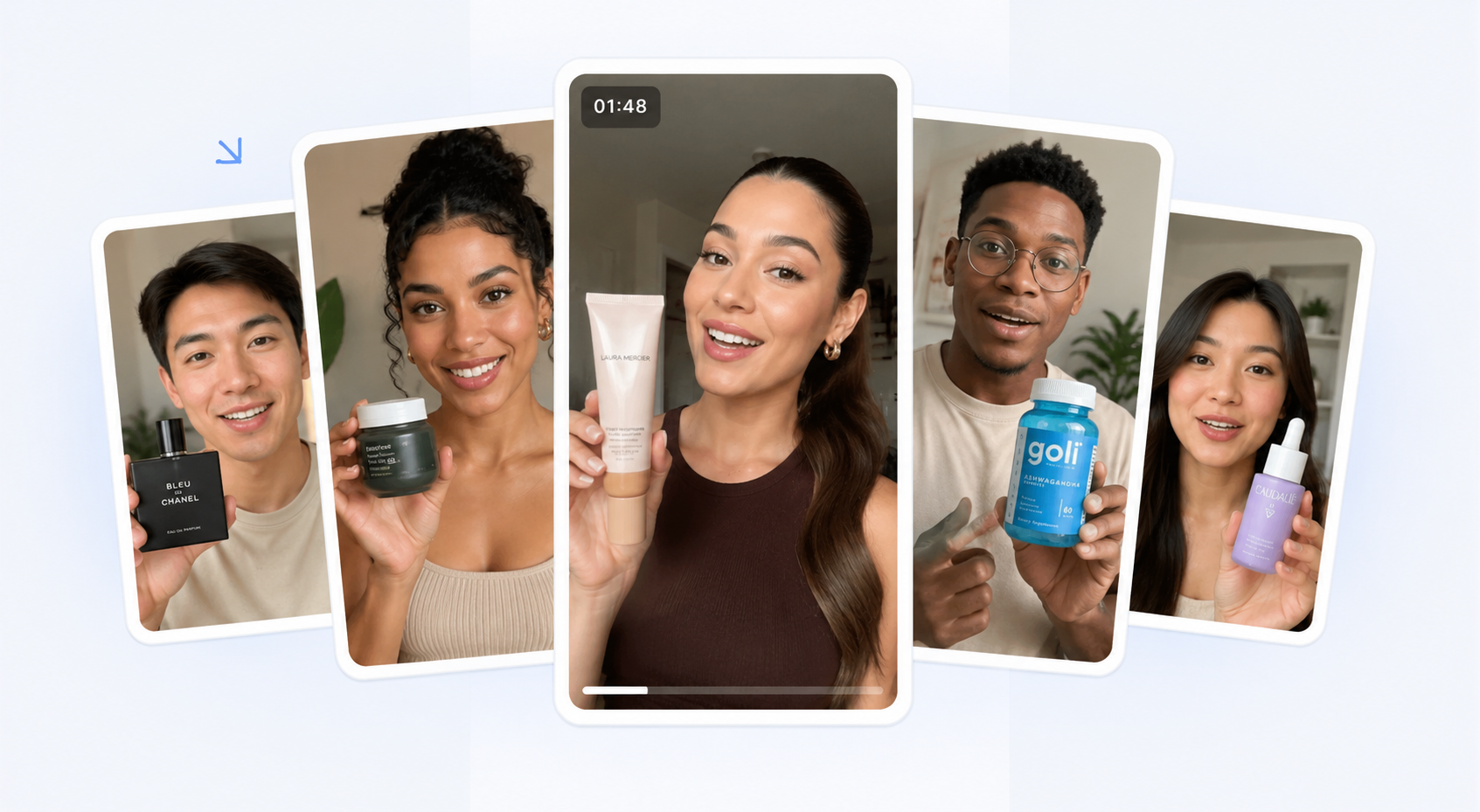
Dropshipping's whole edge is speed: spot a product, validate demand, scale or kill it before the market saturates. The traditional UGC pipeline is built for the opposite rhythm. You would need to order the product to yourself, wait for it, find a creator, negotiate, ship it onward, wait again, and receive a video three weeks after the TikTok trend that surfaced the product peaked.
So most dropshippers historically did one of three things: stole competitors' creatives (account bans, eventually), ran supplier footage everyone else was also running (ad fatigue on arrival), or paid rush fees to agencies (margin gone). The missing piece was creative that moves at product-research speed.
AI UGC is that piece, with one structural advantage nothing else offers: the actor holds a product that never touched your hands. Upload the supplier's listing images to the product-in-hand generator, describe the scene, and get a demo video for an item that is still on a shelf in Shenzhen. For a business model whose core motion is testing products you do not yet stock, that is not a convenience. It is the difference between testing five products a month and one.
The testing loop, hour by hour
Here is the loop as sharp operators run it.
Hour one: product selected from research. Pull the three cleanest supplier images. Write one script with a strong problem-agitation opening, or let the AI script writer draft it and tighten the hook yourself. Generate four variations: two product-in-hand demos with different openings, one talking-actor testimonial, one B-roll-led "look what arrived" cut. That is four credits, under $30 at Studio rates, and the renders finish while you build the campaign shell.
Hour two to three: campaign live at test budget. The videos are watermark-free and royalty-free, so nothing blocks publishing.
Day two or three: the ad account has spoken. Kill on cost-per-click and hold-rate, not opinions. For the survivor, generate three more hook variations against the same body (another ~$18 at Studio rates) and scale what holds.
The discipline that makes this work: kill fast and keep the scripts modular. The same testimonial body with a swapped product name and a fresh hook covers 70% of physical products, which means your second product test costs you 20 minutes of writing, not two hours. Bulk creation, included on every plan, generates the variation set in one pass. One credit equals one finished video, so the cost of a test set is known before you press generate.
The honest failure modes
AI UGC does not fix bad dropshipping, and pretending otherwise would make this page useless. Three failure modes come up repeatedly.
First: generating slop at volume. Fifty near-identical videos teach you nothing and fatigue your own audience. The credit budget is a hypothesis budget; each video should test a different angle (price, problem, skepticism, urgency), or it is wasted regardless of how cheap it was.
Second: product-image quality in, product-image quality out. Supplier listings with watermarked, low-resolution, or heavily composited images produce visibly worse product-in-hand results. Spend the ten minutes finding the supplier's cleanest images, or pull frames from their raw footage. Label-out, well-lit, plain background wins.
Third: the compliance trap. Winning dropshipping ads have always flirted with exaggerated claims, and AI actors will read whatever script you give them with conviction. The ad platforms do not care that an AI said it; the claim rules are the same, and synthetic-content disclosure rules are tightening on top. Write claims you can defend. An AI actor saying something false is still a false ad, delivered more persuasively.
None of these are reasons to skip the tool. They are the difference between operators who compound with it and operators who churn.
Which tool fits the dropshipping motion
The honest tool question for dropshippers is volume math against feature gates, and the full roundup covers all four majors. The short version for this persona:
Arcads is aimed at a different buyer: entry runs about $115 a month (£85) at the time of writing, with no trial listed, and its plans meter avatar-talking seconds rather than videos, which suits agencies more than solo operators; details here.
MakeUGC runs a usage-credit model with no published per-video rate, and product-in-hand sits at its $149 Pro plan rather than lower down. Its perpetual discount banners deserve the skepticism dropshippers apply to everyone else's marketing; the decode is here.
Creatify's URL-to-video is built around catalogue stores more than product-hunters, and its credits meter each generation step rather than each finished video; comparison here.
SmartUGC's pitch to this persona is specific: product-in-hand from $69 (the format that demos an unstocked product), one credit for one finished video so each test's cost is knowable before you run it, five-to-ten-minute renders that keep pace with product research, named models (Seedance 2.0 and Veo 3) on every plan, and a $1 trial to validate against your current product tonight.
Scaling from test to winner
When a product hits, the creative demands change shape: from "many angles, cheap" to "many variations of the winning angle, fast, before fatigue and copycats arrive".
This is where the custom avatar earns its place. Train one from a short clip and your winning "creator" becomes reusable across every scale-up variation, every retargeting cut, and every follow-up product, without the licensing anxiety of a real creator's face on an ad spending four figures a day. Consistency also feeds the algorithm: platforms reward fresh creative, and ten hook-swapped variations of a proven video are the cheapest fresh creative that exists, at roughly $5 each on the Agency plan.
The Agency plan ($249, 50 videos, $5 each) is built for exactly this phase: one or two scaling winners eating 30 videos of variations, with 20 left for the next round of product tests. Credits roll over when you upgrade mid-cycle, so moving up from Studio when a product pops does not strand what you already paid for. If a generation fails, it refunds automatically, so a bad render never quietly eats a credit.
The endgame most operators land on: AI UGC for testing and scale variations, plus one or two real customer testimonials harvested once the product proves out, layered in for the trust anchor. The synthetic volume finds the winner; the human proof closes the skeptics.
- Renders fast enough to test the same day
- A public pricing page with no sign-up wall
- A $1 trial that outputs real, watermark-free ads
- Each test priced before you run it (1 credit = 1 video)
- Product-in-hand demos on a lower plan ($69)
- Custom avatars for a reusable winning creator
- Know exactly what renders your ad
- Scale up without losing what you paid
- Keep running ads after you cancel
Creative at the speed of the motion
Dropshipping rewards whoever compresses the idea-to-data loop hardest. AI UGC removes the slowest link: creative for products you do not stock, at $5 to $7 a video, rendered before the campaign shell is built. It will not save a bad product, and it punishes lazy scripts like any other channel. But run with discipline, it means testing five products in the time the old pipeline tested one. The $1 trial is tonight's product test.
Questions, answered.
Can I make videos for a product I have never received?
Yes, and that is the core dropshipping use case. Upload the supplier’s product images (or paste an image URL) and the product-in-hand generator renders an AI actor holding and demonstrating the item. Clean, well-lit, label-visible source images produce the best results.
How fast can I get a full test set of videos?
Individual videos render in 2 to 10 minutes, and bulk creation generates variation sets in one pass. A four-video test set for a new product is realistically ready within an hour of picking the product, including script time.
What does a product test cost in videos?
A sensible first test is four or five videos: about $24 to $30 at the Studio plan’s $6 per-video rate. A follow-up round for a survivor adds three or four more. Compare against $250 to $1,000 for the same test with human creators, plus weeks of waiting.
How does SmartUGC price a video versus usage credits?
One credit equals one finished video on every SmartUGC plan, so a five-video test is five credits and its cost is fixed before you generate. Some tools meter usage credits per generation step with no published per-video rate, which makes the cost of a test harder to predict up front.
What happens if a generation fails?
Failed generations are refunded automatically, so a broken render never quietly consumes a credit. That matters when you are running a lot of variations against a tight test budget.
Will these ads get my account banned?
The tool does not change platform rules. AI-generated creative is allowed on Meta and TikTok (with evolving synthetic-content disclosure requirements), but exaggerated claims, before-afters in restricted categories, and stolen footage remain bannable regardless of how the video was made. Write defensible scripts; the actor will deliver whatever you give them.
Do the videos have watermarks or usage limits?
No. All generated assets, including trial output, are royalty-free with no usage limits, so you can run them in paid campaigns immediately and keep running them if you later cancel.
Which video models does SmartUGC use?
Seedance 2.0 and Veo 3 are both named and available on every plan, including the trial. You are not guessing which engine renders your ad, and you are not paying more to reach the better model.
Do I need the top plan for product-in-hand videos?
No. Product-in-hand and custom avatars are both included from the $69 Creator plan, so the format that demos an unstocked product does not sit behind the most expensive tier.
Can I cancel if a product cycle ends?
Yes, you can cancel anytime, and because output is royalty-free with no usage limits, ads you already generated keep running after you cancel. Unused credits also roll over when you upgrade mid-cycle.
Related guides
The complete toolkit for
modern advertisers.

One subscription. Unlimited creative.
Create scroll-stopping videos
in seconds.
Start now and cancel at anytime — just $1 for the first 3 days.